Found Community ConversationsJordan & Sarah
Jordan Frith has contributed to improving the lives of young people, the queer community and many others through their advocacy for psychosocial health, at State and National levels. Jordan’s work in the Lived Experience movement requires them to balance authenticity with professionalism, while remaining curious instead of judgemental. A creative at heart Jordan regularly joins us for Collage Club and brings their infectious attitude of curiosity along with them.
Sarah: Now, because I know you work professionally in mental health and lived-experience spaces, I'm curious about the relationship between creativity and wellbeing in your own life.
Jordan: It's complicated. When I was younger, some of my strongest artwork emerged during periods when I wasn't doing well mentally. The creative process wasn't really a choice. It felt necessary. Some of the work I'm most proud of is connected to difficult emotional states. Coming into this project, I wanted something different. I wanted to develop a relationship with creativity that felt joyful. I chose collage partly because I had no experience with it. I collect things obsessively, but I've never really made collages. I've done painting, illustration, clay, glassblowing, floristry—lots of things—but not this. I realised that if I wanted a healthier relationship with art, I needed to become comfortable being a beginner again. Being bad at something for a while. That was important.
Sarah: I love that. This project originally started because a friend of mine was moving back to Seoul. She's an extraordinary artist, but she also has a difficult relationship with creativity. I put together a simple book of art activities. Things I might use with twelve-year-olds when I’m teaching in the classroom. There was no expectation that anyone would ever see the results. The whole point was to reduce the pressure. I often think collage is a beautiful entry point because it feels emotionally neutral. Low-risk.
Jordan: Exactly. The images almost tell you what they want to become.
Sarah: I've always felt that too. Tell me a little about the piece you're making now. The geometric structure feels almost like stained glass. Is that intentional?
Jordan: It's both intentional and accidental. I'm approaching the work step by step rather than with a final vision. Each decision suggests the next one. The image tells you what it wants to be. I've always been interested in retrofuturism. I take Polaroids, listen to cassettes, and love aesthetics that feel suspended between past and future. I'm not working with that explicitly here, but I think elements of it inevitably creep in. Things like stained glass, analogue technology, nostalgia, and imagined futures all live somewhere in the work.
Sarah: That makes complete sense. It's a very elder-millennial feeling somehow!
Jordan: Exactly. There's a nostalgia there, even for things we never fully experienced ourselves.
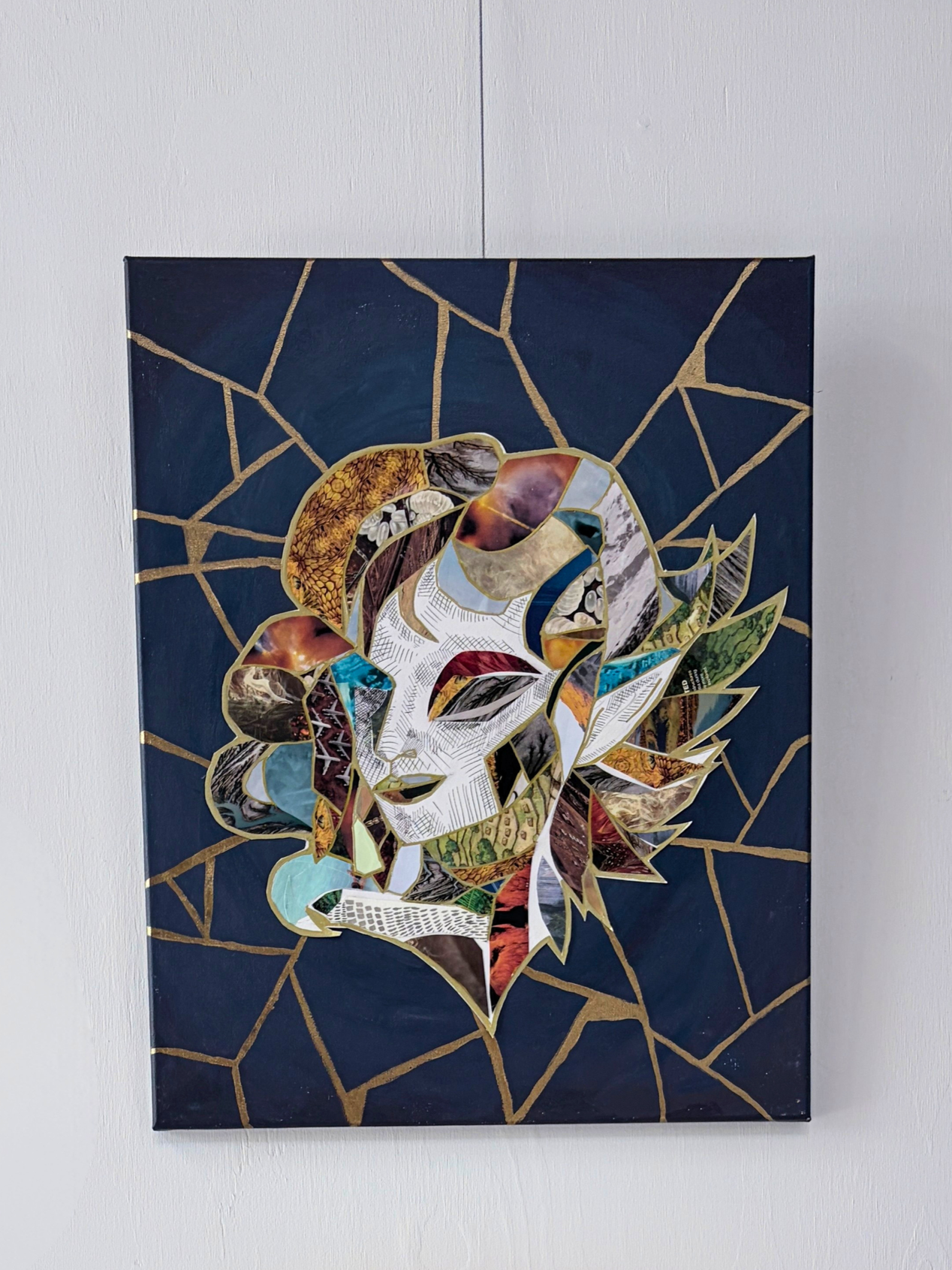
Jordan Frith, "Glue" (2026). Found images, ink and acrylic on canvas.
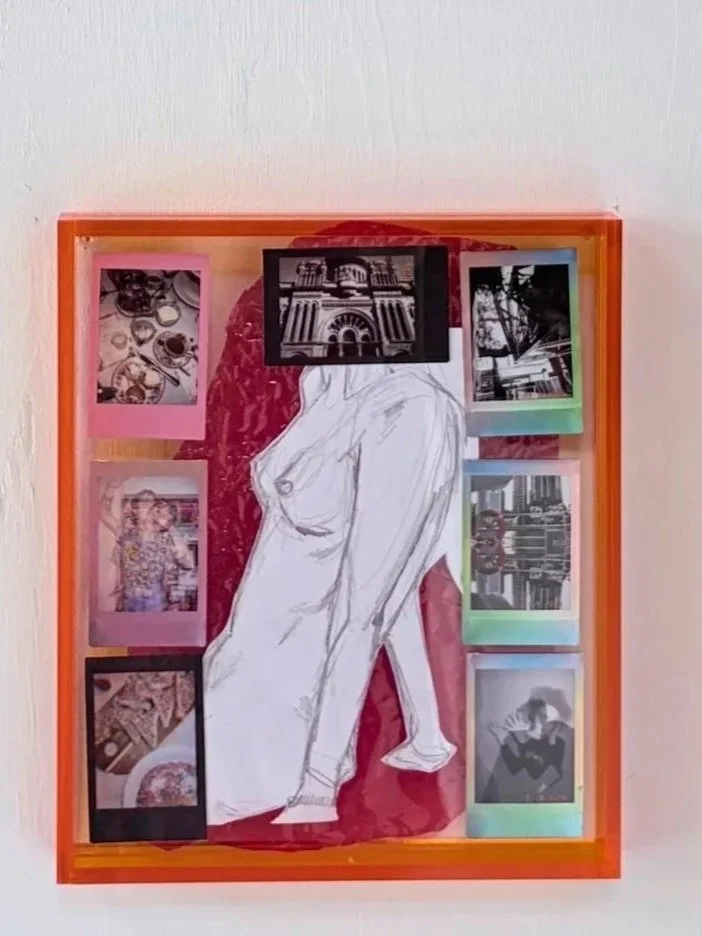
Jordan Frith, "Film" (2026). Polaroid film, cellophane and graphite.