Found Community ConversationsAntoinette & Sarah
Antoinette and Sarah met in 2008, when they both lived and worked in Osaka, Japan. Since then Antoinette returned to her hometown, Toronto, taking the scenic route home via a few years in Ghana. Antoinette is a journalist, pod caster and as Sarah learned, recently dabbled in comedy.
Antoinette agreed to join the postal exchange back in February and this is the first time the two had spoken in any meaningful way for almost they were both living in Japan.
Sarah: So, what's happened? Tell me what's going on in your life.
Antoinette: I'm in Toronto. It's beautiful here. I work in communications and change management at the Science Centre, and I'm also studying psychotherapy in graduate school. The Science Centre is a beloved institution here. People are fiercely passionate about it. Right now it's in the middle of a political cyclone because the provincial government wants to build a new centre on the lakefront as part of a larger entertainment complex. They closed the old Science Centre, which had been there for decades. It sits on what was believed to be protected land surrounded by nature. It's beautiful, and a lot of wildlife was disrupted. The area is also home to many lower-income newcomers, so the Centre was an important part of the community's social ecosystem. Now children have to travel downtown into a tourist area, which isn't as accessible. Long story short, people love the institution but are also angry about what's happened. We're trying to keep people excited about the new building while also acknowledging the loss many people feel. A lot of people have personal connections to the place. They'll say, "My first job was here," or "I live just down the road." It's deeply embedded in the community. So it's actually a really meaningful time to be doing this work, but it's also a strange one. There are tensions everywhere. Alongside that, I host a podcast, which I'm really loving. It's helping me build my network in a way that feels authentic to what I already enjoy doing.
Sarah: That's brilliant. I don't think you ever told me what your podcast is called.
Antoinette: It's called Culture Alchemy. It's a video and audio podcast. You can find it on Spotify, Apple Podcasts, YouTube, or pretty much anywhere you get podcasts.
Sarah:
That's exciting. I'm actually a bit of a podcast snob. I find them difficult to listen to, but I do religiously listen to Ologies. I don't know if you know it. You probably would, being interested in science.
Antoinette: That's interesting. I never expect anyone to listen to my podcast. It's definitely abstract and a little tangential.
Sarah: That sounds right up my alley.
Antoinette: I think you'd like it. It started as a project with a co-host I met on a dating app. We created the podcast together, but eventually I continued on my own. Once I realised it needed to become a solo project, everything changed. I stopped trying to make it fit someone else's vision and simply made the show I wanted to make. After that, I became much more consistent with publishing. Collaborations started appearing. Interesting guests came into my orbit. I'd meet someone and think, "Wow, your story would make a fantastic conversation." The whole thing just came together. It's given me a lot of creative freedom.
Sarah: That's really cool. There are some parallels with your work and with this art project I've been running. What I've found is that people just want to know about other people. At the end of the day, they want connection. This recording is happening because you sent me a beautiful artwork. I haven't received it yet, but I'm excitedly waiting for it. Whenever I take artworks into our fortnightly community workshops and show people what has arrived in the mail, everyone wants to see the artwork, of course. But then the conversation immediately becomes: "Who made this?" “Where do they live?" "What do they do?" Are they an artist?" People want to understand the person. I find that fascinating. More often than not, that's where the conversation goes. People want to understand the creator so they can better understand the work. It's a beautiful thing to watch.
Antoinette: I completely relate to that because it's exactly what I'm trying to do on the podcast. I'm interested in why a cultural artefact becomes significant. What does it say about the moment we're living through? Why do we care about a particular person or piece of work? Their backstory affects how we see their art and how we interpret what they've created. Which leads to that perennial question: can you separate the art from the artist? We still appreciate Picasso, for example. Actually, the Met Gala recently changed course because of controversy surrounding John Galliano. The original theme was going to centre on him, but there was significant backlash online. People felt it was the wrong moment to honour him. Eventually the organisers decided it wasn't worth the controversy. They scrapped the concept and moved in another direction.
(Antoinette’s connection drops out)
Antoinette: Right. We were talking about the connection between podcasting, your project, and storytelling. I'm loving it. I'm speaking to people from all over the world and hearing their stories. I've had writers on, artists on, all sorts of creative people. We talk about their process, how they found their work, and how they became artists. What I've found is that there really isn't a separation between the art and the person. Their story informs their work. Sometimes their art even saves them. I've met so many fascinating people simply because I turned on a microphone and declared, "I'm going to make a podcast." It's been surprisingly liberating creatively. The podcast began at a time when I was grieving a friend who had recently died. I was carrying a lot of emotion and didn't really know how to process it. The act of creating gave me somewhere to put that energy. It became part of my healing earlier this year.
Sarah: That's wonderful. You may or may not end up quoted in my research.
Antoinette: I'd be honoured!
Sarah: Community development in Australia has become increasingly clinical in recent years. A lot of community-based preventative health initiatives lost funding. Programmes designed to bring people together were dismantled. What you're saying about connection really resonates. We're increasingly isolated. One of the beautiful things about artistic practice is it’s inherently social. You need feedback. You engage with other people. There's something powerful about re-authoring your personal narrative through creative expression. Connection with others is absolutely crucial to wellbeing.
Antoinette: Absolutely. I really enjoyed participating in your project, Sarah. What's funny is that the day you reached out to check in was actually the day I intended to mail the piece. I had everything packed and ready to go.
Sarah: That's amazing. I had just sent a message to everyone saying, "We've got an exhibition coming up. If your work is ready, please put it in the mail." Partly because my friend in Oslo, who originally started this project with me, sent a package in January and I still haven't received it. She even sent a follow-up package. Nothing. I genuinely can't seem to get a package from Norway.
Antoinette: That's wild. You should be able to track those down.
Sarah: Right?! I also have to remind myself, these artworks are favours from friends. I hate being a pest, repeatedly sending messages asking for tracking numbers because I've been on the receiving end of those messages myself.
Antoinette: Honestly, I appreciated the nudge. I kept looking at the package and telling myself I was going to do it. Then somehow I never got around to it. I told myself I wanted it finished by the end of summer, but something kept stopping me. Maybe there was some psychological resistance. I kept saying I was too busy. But I wasn't. I watched an entire season of television.
Sarah: I know that battle well.
Antoinette: Exactly. Maybe I was putting pressure on myself. Maybe I was asking, "What am I going to make? Is it good enough?"
Sarah: Was there anxiety about contributing to someone else's project? Worrying whether it would be what I wanted?
Antoinette: Possibly. Once I let go of those expectations and reminded myself there were no rules, something clicked. I started ripping materials apart and playing with them. The tactile experience led me somewhere unexpected. Images began appearing. I started meditating on what was in front of me. Suddenly I had a complete vision. The piece became about what I wanted to call into my life this year. By the end of it, I'd created this elaborate pop-up book. It felt like all the pieces came together at once. I took photos of it, but I don't want to show you. I'd rather you experience it when it arrives.
Sarah: I kinda want to see but I love the surprise when I open the mail!
Antoinette: Well I took photos of it, lit up by a lava lamp.
Sarah: Now I have to see!
(Both laughing, Antoinette shares her photograph).
Sarah: Oh wow! I love how textural it is. I love that you've taken it into three dimensions.
Antoinette: It was so much fun. Making pop-up books as a child was one of my favourite things. I loved building things, crafting things, figuring out how paper could fold, spring open, and transform. Working on this piece brought me back to that space. I realised that when I was a kid, I was always foraging for materials. I wasn't particularly handy, but I was very crafty. I made things out of whatever was around me. That's part of why I loved Japan so much. I was fascinated by the attention given to materials and craft. I was trying to remember the name of the art form where broken pottery is repaired—
Sarah: Kintsugi?
Antoinette: Exactly! The idea that something broken can become more beautiful because it has been repaired. There are so many examples in Japanese culture of honouring materials, paper, objects, and process. This project tapped into that instinct for me. I wanted to build a scene and create something tangible from what was available around me.
One of the things that's been really meaningful is that I'm currently training as a psychotherapist.
Sarah: Oh, cool.
Antoinette: We do a lot of art therapy, and I find it incredibly healing.
Sarah: I think creative health is absolutely crucial. Having worked in that space for a long time, I've never seen anyone simply take some pills and get better. Art therapy and music therapy are well established, but I'm also interested in creative activity without formal therapeutic framing. People gather, make something together, connect with one another, and often feel better as a result.
Antoinette: If I understand correctly, you're interested in the healing potential of art without necessarily guiding people through a therapeutic process.
Sarah: Exactly. The act of creating and the act of connecting with other people can be therapeutic in themselves. There's absolutely a role for therapists and clinicians, but there's also something powerful about simply bringing people together to make things.
Antoinette: That makes complete sense.
Sarah: I keep thinking about the conversation we were having earlier about John Galliano. It's interesting because I thought people would focus more on questions of cultural appropriation than anything else.
Antoinette: That's definitely part of it. But I think there is also a heightened sensitivity in culture right now. Social media creates enormous pressure. Once enough people focus on an issue, it becomes very difficult to ignore. In Galliano's case, the controversy ended up overshadowing whatever the organisers originally hoped to celebrate.
Sarah: My understanding is that he ultimately stepped aside himself.
Antoinette: That's what I've heard too. And honestly, it circles back to the question of whether we can separate the art from the artist. That conversation appears everywhere. I often find that once I know more about a director, painter, or creator, I start noticing recurring themes in their work. Their biography inevitably shapes how I understand what they've made.
Sarah: It's such a difficult question. How much do we judge people for actions that were considered acceptable in a different era? Then again, some of the people we discuss today weren't considered acceptable even in their own time. People objected to Picasso's behaviour while he was alive. People objected to Gauguin while he was alive. So it's not always a matter of judging historical figures by modern standards.
Antoinette: Exactly. Actually, have you seen the new A24 film The Drama?
Sarah: Not yet.
Antoinette: It's a fascinating film. Robert Pattinson and Zendaya play an engaged couple at a dinner party where a group of friends begin revealing the worst things they've ever done. There's a major secret at the centre of the story, and because it touches on gun violence I wondered whether Australian audiences might respond differently to it.
Sarah: I've seen it advertised.
Antoinette: It's an excellent film. Actually, I brought it up because it connects back to the art-versus-artist question. Pattinson's character teaches at an elite art school, and the film is full of conversations about art, ethics, morality, responsibility, and relationships. I think you and Simon would have a fantastic conversation afterwards because the film constantly asks, "What would you do?" There are multiple points where you're forced to consider how you would respond if you found yourself in the same situation.
Sarah: Perfect. We'll definitely watch it.
Antoinette: You really can't leave that film without asking yourself difficult questions. Would this change how I see my partner? Would it change how I see my friends? Would it be a dealbreaker? It's one of those films that lingers. When I saw it in the cinema, the audience was reacting constantly. There were gasps, laughter, emotional responses, people turning to each other and whispering during the revelations. There was a real sense of collective discovery as the story unfolded. Some people were genuinely losing their minds over it.
Sarah: That's fascinating. My study is focused on dance and creative practice, and last night Simon and I went to a contemporary dance performance as part of Brisbane's arts festival. It's my favourite time of year because artists from everywhere come through. We get incredible performances, community events, and cultural programmes. The company we saw last night is based on the Gold Coast. People know the Gold Coast internationally, but not necessarily as a centre for experimental contemporary dance. So I was interested to see what they were doing. The performance was really great. The whole work explored death and grief, but it was also funny and surreal. It felt a little David Lynch-esque. There was even a scene where the Grim Reaper arrived at a party wearing a ridiculous sequinned costume. For my own practice, I work primarily in contemporary dance now, but I also love flamenco. One thing I love about flamenco is the audience relationship. The audience is loud. If somebody dances beautifully, people shout encouragement and appreciation. The audience becomes part of the performance. If the audience is quiet, that's a bad sign. I once attended a flamenco performance in Brisbane where part of the audience clearly understood that tradition. They were going off, cheering and yelling out constantly, while the rest of the audience sat in stunned silence wondering whether that behaviour was allowed or not! That contrast fascinated me. At this performance last night, a woman sitting beside me came alone and was laughing out loud and talking to me throughout. It was wonderful. By the end of the performance, the dancers carried a huge piece of fabric over the audience. It floated across the room like a cloud. Nobody instructed us to touch it, but everyone instinctively reached up and interacted with it. The audience became part of the artwork. What struck me most was that they'd created an environment where people felt comfortable responding rather than sitting silently. That's why your story about people reacting in the cinema fascinated me. It's becoming increasingly rare.
Antoinette: That sounds absolutely beautiful. I could picture the entire thing while you were describing it. And honestly, that's exactly how I felt in the cinema. Going to the movies feels more like an event now. It's expensive, and people don't go nearly as often. So when something genuinely succeeds in drawing people out, there's a sense of occasion attached to it. This film had strong marketing, recognisable actors, and an intriguing mystery. People wanted to know what the secret was. That curiosity drew everyone in. Once we were there, the audience became part of the experience. People reacted exactly where the screenwriter clearly intended them to react. There were gasps during the dinner scene. There were gasps during the wedding scene. I found myself laughing partly because other people's reactions were so intense. One woman beside me was literally clutching at her pearls in shock. I thought it was delightful.
Sarah: That's amazing.
Antoinette: What I loved most was that nobody was looking at their phones. Everybody was fully present. The whole room felt synchronised. I think that's one reason horror is so successful at the moment. At least in North America, two of the biggest films this summer came from creators who originally built audiences online and then made horror or psychological thriller films. Fear is collective. Comedy can be very culturally specific. Humour changes from place to place. Fear is more universal. A room full of people experiencing fear together creates an entirely different kind of communal experience.
Sarah: Absolutely. Australia has always had strong connections to British humour because of our colonial history. I grew up watching things like Fawlty Towers and Monty Python. So there was always a tendency to connect more strongly with British-style comedy than certain American comedians or sitcoms. Sometimes I'd watch something and wonder why it wasn't landing, then realise the creator was working from an entirely different cultural reference point. It's fascinating.
Antoinette: I had exactly the same experience when I first arrived in Japan. At first I couldn't understand why certain things were funny. I had to learn more about the culture before I could appreciate the humour. Fear works differently. Fear is primal. You don't need cultural knowledge to understand suspense, tension, dread, or danger. That's why horror travels so effectively. You don't necessarily need to see violence. Even Hitchcock understood that implication could be more powerful than explicit imagery. What matters is the emotional response. That's why I think these communal horror experiences are resonating at the moment. People want to experience something together.
Sarah: That reminds me of an anthropologist I follow on Instagram. She's been working with communities in Africa, but I can’t remember the specific country! How annoying! But she was talking about gossip. We often think of gossip as inherently negative, but her argument was that everyone gossips because gossip serves a social purpose. It's a way of sharing information and confirming social norms. Someone says, "This person did this thing. What do you think?" And collectively we decide whether it's acceptable or not. She noticed that the longer she worked within a community, the more people gossiped with her. Not because they were malicious, but because she had become a trusted person who could safely hold information. I thought that was beautiful. It made me wonder whether part of what attracts people to films like The Drama is the opportunity to witness other people's secrets and moral dilemmas.
Antoinette: I think you've hit on something there. The film isn't driven by action. It's driven by conversation, secrets, and the consequences of revelation. People become fascinated because they're constantly asking themselves, "What would I do in this situation?" Would this change how I see someone? Would it be a dealbreaker? And yes, I recently saw a discussion about the social function of gossip too. It absolutely plays a bonding role in communities. Even in workplaces, gossip often functions as a way of creating social connection and belonging. Obviously it can become destructive, but it also serves an important social purpose. That actually connects to something else I wanted to say about secrets. People are fascinated by secrets. And they're fascinated by people who hold them. That's one reason therapists have become such prominent characters in contemporary storytelling. I have a psychologist friend in Miami who occasionally comes onto the podcast, and we often discuss fictional characters. At one point I started noticing how many recent films and television shows centre around therapists. Shrinking. The Sopranos. Frasier. Countless films and prestige dramas. Therapists keep showing up.
Sarah:
Well, The Sopranos was practically built around therapy.
Antoinette: Exactly. And when I asked my psychologist friend why he thought people were so interested in therapists as characters, his answer was simple: "We hold secrets." People find that compelling. Therapists occupy a strange cultural position. They're trusted with information that nobody else gets to hear. That dynamic naturally lends itself to storytelling.
Sarah: That's fascinating. Do people treat you differently now that you're studying psychotherapy? Do people you've known for years relate to you differently? I wonder whether some people become self-conscious because they imagine you're analysing them.
Antoinette: Yes. The answer is definitely yes. It's interesting because I'm not even practising yet. I'm three years into a five-year training programme. But even at this stage, people respond differently. I've noticed that my own relationships have changed too. Take my younger sister, for example. We've had a tense relationship for most of our lives. A lot of it came down to birth order dynamics. I'm the eldest. From her perspective, I was the golden child. She got the hand-me-downs. My younger brother arrived later and benefited from a different version of our parents than either of us experienced. We grew up in very different circumstances despite being in the same family. Our parents were newcomers to Canada and were figuring everything out while raising me. My siblings inherited parents who already had more experience. Those differences shaped all of us. But one thing psychotherapy training has done is completely change how I relate to people. My understanding of relationships has changed. So naturally, my relationships have changed too. My boundaries are much firmer now. At the same time, I have far more grace. My family is much closer now. We're all travelling to Ghana together for Christmas this year. It's a big family trip. My sister and I are actually friends again. A lot of healing has happened over the last couple of years. I've had to acknowledge a great deal of anger and sadness connected to my family experiences. Working through those things has strengthened those relationships. Because my family knows what I'm studying, they often joke that my coursework gives me permission to ask questions. It gives me a doorway into people's stories. In some ways it's very similar to journalism, podcasting, and storytelling. I've always been interested in asking, "What's your story?" That's why I feel drawn to this work. The diorama I created for your project reflected that idea too. It made me realise there may be another way to think about myself as an artist, or perhaps an artivist. There has always been an element of activism woven through the creative work I've done.
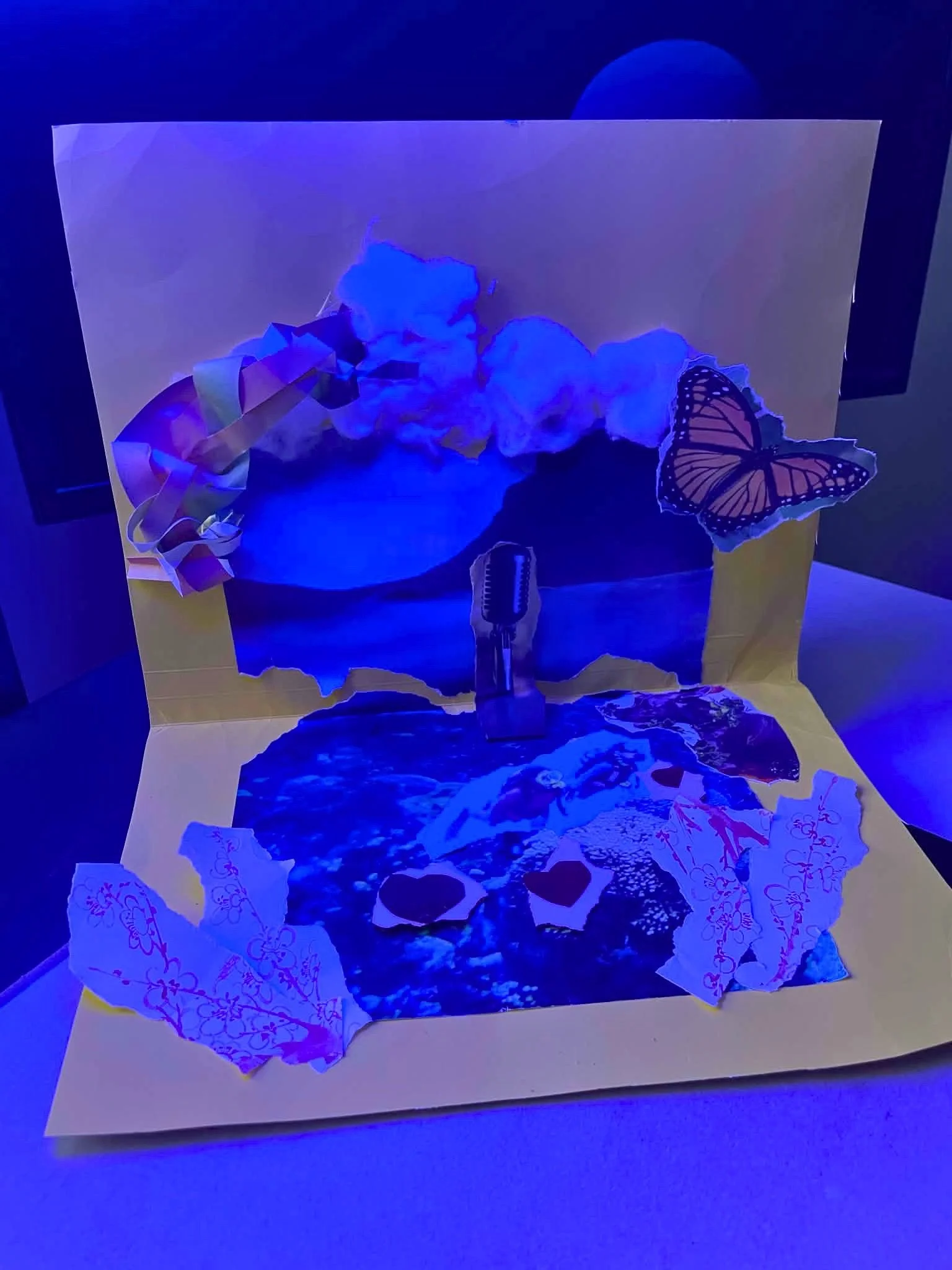
Antoinette Sarpong, "Finding my frequency" (2026). Mixed media collage and found images on paper.